

Breville Barista Express BES870XL Review: An All-in-One Espresso Machine for Home Baristas
Affiliate Disclosure: As an Amazon Associate I earn from qualifying purchases.
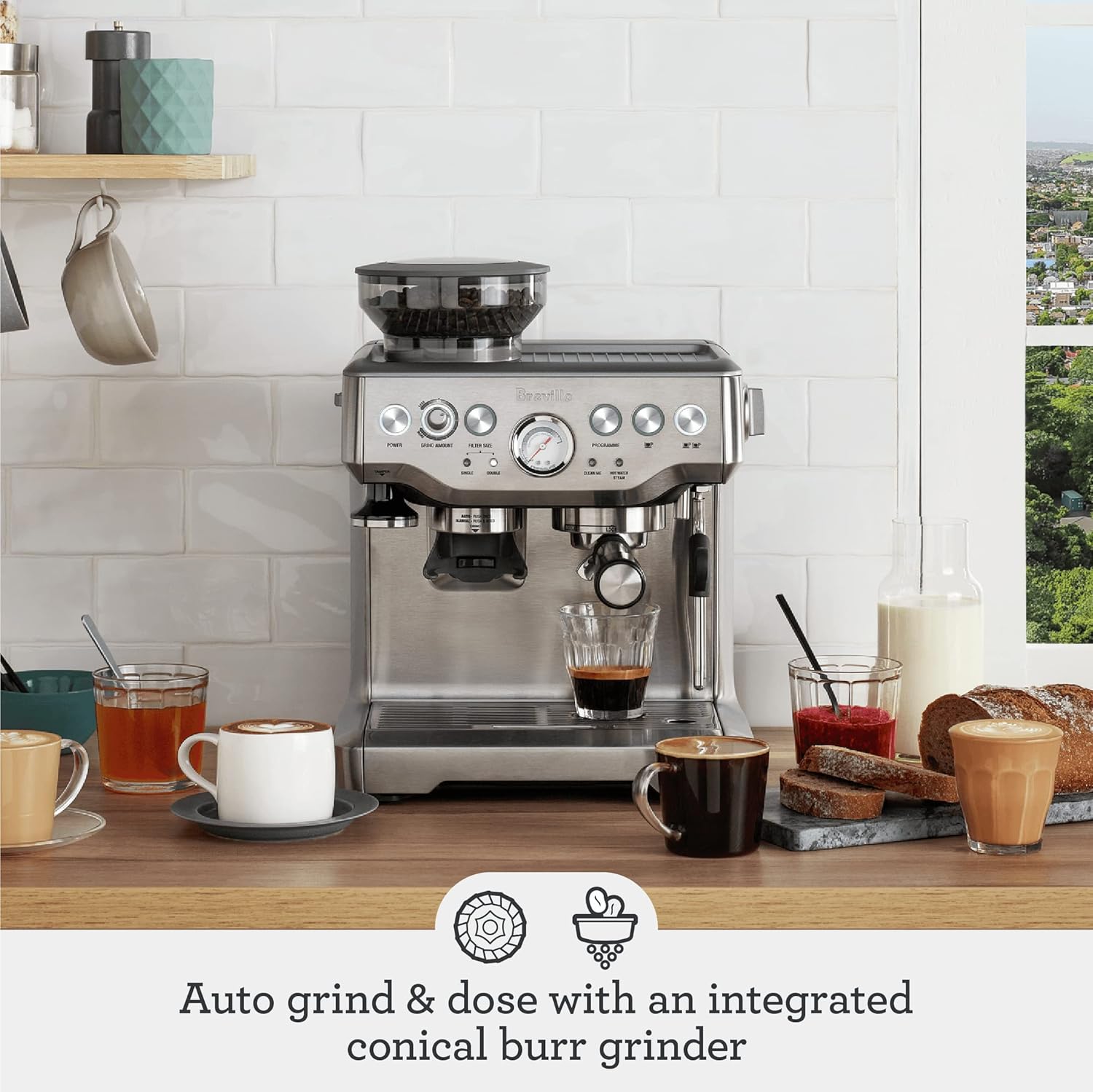
For coffee enthusiasts who want more control over their morning espresso without filling the kitchen counter with several separate appliances, the Breville Barista Express BES870XL presents an interesting all-in-one solution. It combines an espresso machine, a conical burr grinder, manual milk steaming, and adjustable brewing controls in a single stainless-steel appliance.
Rather than focusing on one-touch automation, the Barista Express is designed for people who want to participate in the espresso-making process. You grind the beans, adjust the dose, tamp the coffee, monitor extraction, and texture the milk manually.
That makes it quite different from fully automatic coffee machines. The extra involvement creates a learning curve, but it also gives users significantly more control over how their espresso is prepared.
In this Breville Barista Express review, we will examine its main features, brewing system, grinder, milk-steaming capabilities, ease of use, maintenance requirements, advantages, limitations, and the type of coffee drinker it is best suited for.
Breville Barista Express BES870XL Overview
The Breville Barista Express is a semi-automatic espresso machine with an integrated precision conical burr grinder. Its purpose is to streamline the bean-to-cup process while preserving many of the manual controls associated with traditional espresso preparation.
Instead of purchasing an espresso machine and grinder separately, both functions are incorporated into one unit.
Some of its key specifications include:
- Integrated conical burr coffee grinder
- Adjustable grind-size dial
- Adjustable grind amount
- 54mm stainless-steel portafilter
- Low-pressure pre-infusion
- Digital PID temperature control
- Manual steam wand
- Single- and double-shot controls
- Manual extraction option
- 67 oz removable water tank
- 1/2 lb bean hopper
- 1600-watt power rating
- Integrated tamper
- Stainless-steel milk jug
- Single- and dual-wall filter baskets
These features position the Barista Express between basic home espresso machines and more advanced setups that require purchasing a separate grinder and espresso machine.
Integrated Conical Burr Grinder
One of the most important features of the Breville Barista Express is its built-in grinder.
Freshly grinding coffee immediately before brewing can be an important part of espresso preparation because grind size, consistency, and dose all influence extraction.
The machine’s conical burr grinder grinds beans on demand and dispenses the ground coffee directly into the portafilter.
This reduces the number of separate steps involved compared with using a standalone grinder.
The grind-size dial allows users to adjust how coarse or fine the coffee is ground. This is particularly useful when experimenting with different beans because espresso extraction may require adjustments depending on roast level, freshness, and other variables.
There is also a grind-amount control, allowing the dose to be adjusted.
For beginners, finding the correct grind setting may require some trial and error. However, learning how grind size affects espresso is part of what makes this machine attractive to people interested in developing basic home-barista skills.
54mm Portafilter and Dose Control
The Barista Express uses a 54mm stainless-steel portafilter.
Coffee is ground directly into the portafilter using the integrated grinding cradle. After dosing, the grounds can be tamped with the machine’s integrated tamper.
Breville also includes its Razor Dose Trimming Tool, which is designed to help level the coffee dose after tamping.
The machine includes both single-wall and dual-wall filter baskets for single and double shots.
Dual-wall baskets can be more forgiving when using pre-ground coffee or when the grind and dose are not perfectly dialed in. Single-wall baskets provide greater control for users who want to adjust variables such as grind size, dose, and tamping technique more precisely.
Having both options makes the machine accessible to beginners while still leaving room for experimentation.
Low-Pressure Pre-Infusion
Proper extraction is central to producing espresso.
The Barista Express uses low-pressure pre-infusion, which introduces water to the coffee puck gradually before full extraction pressure is applied.
The idea is to saturate the grounds more evenly before the main extraction begins.
Uneven saturation can contribute to channeling, where water finds easier paths through certain sections of the coffee puck rather than extracting evenly across the entire surface.
Pre-infusion is therefore a useful feature for a semi-automatic machine aimed at home users who want more control over espresso quality.
PID Digital Temperature Control
Temperature stability is another important variable in espresso preparation.
The Breville Barista Express incorporates digital PID temperature control to regulate the temperature of the water used during extraction.
Maintaining a consistent brewing temperature can help produce more repeatable results from one shot to another.
For home users, this means fewer variables need to be controlled manually. You can concentrate more on grind size, dose, distribution, and tamping while the machine manages brewing temperature electronically.
It does not remove the skill involved in espresso preparation, but it provides a more consistent foundation for experimentation.
Espresso Pressure Gauge
One of the most recognizable features on the front of the Barista Express is its analog espresso pressure gauge.
The gauge provides visual feedback during extraction.
It can be especially useful while learning to dial in coffee because the extraction behavior can help indicate whether adjustments may be required.
For example, an overly coarse grind or insufficient coffee dose can cause water to pass through the grounds too quickly, while an excessively fine grind may slow extraction substantially.
The gauge should not be treated as the only measure of espresso quality, but combined with extraction time, flow, and the final beverage, it provides another useful point of reference.
Manual Steam Wand for Milk Drinks
Anyone who regularly prepares cappuccinos, lattes, flat whites, or similar drinks will likely spend considerable time using the steam wand.
Unlike fully automatic systems that froth milk at the push of a button, the Barista Express uses manual milk texturing.
The steam wand lets you control the angle, milk movement, temperature, and amount of air introduced into the milk.
With practice, it can create fine microfoam suitable for espresso-based milk drinks and basic latte art.
The advantage is control.
The disadvantage is that learning to texture milk correctly requires practice.
Someone who simply wants to press one button and receive a finished cappuccino may find a fully automatic machine more convenient. Someone interested in learning milk steaming, however, may appreciate the manual system.
Bean-to-Espresso Workflow
The machine is designed to bring most of the espresso preparation process into one station.
A typical workflow looks like this:
- Add fresh coffee beans to the hopper.
- Select an appropriate grind size.
- Grind coffee directly into the portafilter.
- Distribute and tamp the coffee.
- Insert the portafilter into the group head.
- Select a single or double extraction.
- Steam milk separately when preparing a milk-based drink.
- Clean the portafilter and steam wand after preparation.
Breville describes the machine as capable of moving from beans to espresso in under a minute under suitable conditions.
Actual preparation time will naturally depend on the user’s workflow, whether milk is being steamed, and how much adjustment is necessary.
Water Tank and Bean Hopper Capacity
The 67 oz water tank provides enough capacity that most home users should not need to refill the machine after every drink.
The removable design also makes filling and cleaning more convenient.
A water filter and filter holder are included with the machine.
At the top of the unit is a 1/2 lb bean hopper, allowing coffee beans to remain ready for grinding.
Users who frequently change between different coffee beans may prefer keeping smaller quantities in the hopper rather than filling it completely.
Controls and Ease of Use
The Barista Express uses physical buttons, dials, and an analog pressure gauge rather than a touchscreen-heavy interface.
There are controls for grinding amount, grind size, filter size, single and double shots, and manual brewing.
Beginners should expect a learning period.
Unlike pod machines or fully automatic espresso makers, good results depend partly on understanding several variables:
- Coffee freshness
- Grind size
- Coffee dose
- Distribution
- Tamping
- Extraction time
- Milk-steaming technique
Once a preferred recipe is established, however, the daily workflow can become considerably faster and more predictable.
This balance between automation and manual control is arguably the defining characteristic of the Barista Express.
Build and Countertop Design
The BES870XL version features a brushed stainless-steel exterior that gives the machine the appearance of traditional café equipment.
Because the grinder is built into the machine, the overall setup can also be more compact than using a large standalone grinder next to an espresso machine.
However, it remains a substantial countertop appliance.
Before purchasing, it is sensible to consider both the available counter width and the vertical clearance beneath kitchen cabinets, particularly because beans need to be added through the hopper at the top.
Included Accessories
Breville includes a useful collection of accessories with the machine.
The package includes a 54mm stainless-steel portafilter, single- and double-shot filter baskets, single- and dual-wall baskets, stainless-steel milk jug, integrated tamper, coffee scoop, Razor Dose Trimming Tool, water filter and holder, cleaning disc, cleaning tablets, cleaning brush, and an Allen key.
Having the essential espresso tools included reduces the number of additional accessories required to begin making drinks.
Users may eventually choose to purchase specialized accessories as their technique develops, but they are not necessary for getting started.
Cleaning and Maintenance
Espresso machines require regular cleaning, and the Barista Express is no exception.
After preparing coffee, the portafilter and basket should be rinsed and residual coffee grounds removed.
The steam wand should also be wiped and purged shortly after steaming milk to prevent milk residue from drying inside or around the wand.
The drip tray requires periodic emptying and washing.
The machine also includes cleaning accessories for more thorough maintenance.
The water filter will need periodic replacement depending on usage and water conditions.
Good maintenance is particularly important for an espresso machine because coffee oils, fine grounds, milk residue, and mineral deposits can gradually affect performance.
Advantages of the Breville Barista Express
Integrated Grinder
Combining the grinder and espresso machine simplifies the countertop setup and makes it possible to grind beans directly into the portafilter.
Adjustable Espresso Variables
Users can modify grind size, grind amount, shot selection, and other preparation variables rather than relying entirely on automatic presets.
PID Temperature Control
Digital temperature regulation helps maintain more consistent brewing conditions.
Manual Milk Texturing
The steam wand gives users direct control over milk texture and provides an opportunity to develop latte-art skills.
Beginner-Friendly Filter Options
Single- and dual-wall baskets allow users to start with a more forgiving setup and transition toward greater manual control.
Included Accessories
The package provides most of the essential tools required to begin preparing espresso drinks.
Potential Limitations
No espresso machine is ideal for every type of coffee drinker.
Learning Curve
The Barista Express requires more involvement than fully automatic machines. Grind settings, dosing, tamping, extraction, and milk steaming all require practice.
Manual Workflow
Preparing several drinks consecutively takes more effort than using a one-touch automatic coffee machine.
Integrated Grinder Trade-Off
The integrated grinder is convenient, but experienced espresso enthusiasts who want maximum grinder flexibility may eventually prefer a dedicated standalone grinder.
Regular Cleaning Required
The grinder, portafilter, group area, steam wand, drip tray, and water system all require ongoing maintenance.
Counter Space
Although an integrated design can save space compared with two separate appliances, the machine itself still occupies a noticeable portion of the countertop.
Who Is the Breville Barista Express Best For?
The Barista Express makes the most sense for users who want to learn the fundamentals of espresso preparation while keeping the equipment setup relatively simple.
It may be particularly suitable for:
- Coffee drinkers moving beyond pod machines
- People who want freshly ground coffee for every espresso
- Home users interested in learning espresso preparation
- Cappuccino and latte drinkers who want manual milk control
- Buyers who prefer an integrated grinder
- Users who enjoy adjusting recipes for different coffee beans
It may be less suitable for someone who prioritizes complete automation above manual control.
If your ideal coffee routine is pressing a single button and walking away, a fully automatic espresso machine may be a better match.
Final Verdict
The Breville Barista Express BES870XL occupies an appealing middle ground in the home espresso market.
It simplifies the equipment setup by integrating a conical burr grinder with a semi-automatic espresso machine, while still giving the user meaningful control over grind size, dose, extraction, and milk texture.
Features such as low-pressure pre-infusion, PID digital temperature control, the 54mm portafilter, adjustable grinding, pressure feedback, and the manual steam wand create a platform that beginners can grow into rather than immediately outgrow.
The main consideration is involvement.
This is not a machine designed to eliminate the barista from the process. It is designed to give the home user the tools needed to become more involved in preparing espresso.
For someone who enjoys experimenting with coffee beans, adjusting the grind, learning extraction technique, and practicing milk texturing, the Barista Express offers an accessible path into home espresso without requiring a completely separate grinder and brewing setup.
For buyers who value that combination of convenience and manual control, the Breville Barista Express BES870XL is worth considering as an all-in-one home espresso setup.
Check the latest availability and product details on Amazon before purchasing.
🛒 View at Amazon(affiliate link)